Gas to Energy
Landfill Gas-to-Energy Facility (2010-2022)
 When Will County proposed building a landfill at the former Joliet Arsenal site, a provision for a gas-to-energy facility was written into the original plan. This provision was specifically included because all landfills generate methane gas as garbage decomposes. Per Federal regulations, this gas must be collected and flared off. Another possible use for this methane gas is converting it into electricity.
Thanks to the American Recovery and Reinvestment Act of 2009, and subsequent Department of Energy EECBG (Energy Efficiency Conservation Block Grant)funds, Will County was able to break ground on the building of a gas-to-energy plant in the fall of 2010. This landfill gas-to-energy plant which opened in December of 2011, pulls the majority of methane gas generated by the landfill through two to eight Caterpillar generators that will turn the gas into electricity. Our plant generated enough power in 2012 to provide all the energy needs of 2,000 to 3,800 homes. By the time the plant is complete (which takes several years as the landfill continues to take in more waste), the GTE plant is projected to power 7,800 homes annually. The cost of the plant was approximately $9 million and the County partnered with Waste Management to build and fully fund the cost. The County contributed $1 million of the EECBG funds and the county owns the gas rights as the owner of the landfill. Therefore, the County will receive revenue from the sale of the electricity generated by the gas. Click Here for Waste Management Power Point Presentation
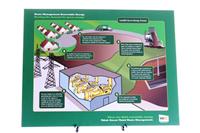
Landfill Gas-to-Energy Process:
-
Landfill gas is created when waste in a landfill decomposes
-
This gas is about 50% methane and 40% carbon dioxide with traces of other gases
-
An electric generating plant using landfill gas and one using natural gas or diesel fuel are similar.
Three Basic Components:
1. Gas Collection System: Gas is collected from decomposing waste by a series of wells strategically placed throughout the landfill. The number and spacing of wells depend on specific aspects such as volume, density, and moisture content. Wells are constructed by drilling holes to within 15 feet of the bottom of the landfill. Perforated plastic pipes are inserted into the wells. The area around the pipes is filled with large gravel to prevent refuse from plugging the perforations. The wells are connected by a series of pipes leading to larger, header pipes that deliver the gas to the energy facility. The entire piping system is under a vacuum created by blowers at the energy facility, causing landfill gas to flow from the wells.
2. Energy Facility: Once blowers deliver the gas to the energy facility, internal combustion engines use the gas as fuel and spin generators to produce electricity.
3. Grid Connection: After the gas is converted to electricity, a dedicated power line is used to deliver the electricity to the power distribution system. Grid connection includes metering equipment necessary to monitor sales and system protection equipment with emergency shutdown capability.
Environmental Issues:
-
The decomposition of waste in landfills produces a gas which is composed primarily of methane and carbon dioxide. These compounds contribute to the formation of ozone, a primary cause of smog and are also greenhouse gases contributing to global climate change. Landfills are the largest source of human-based methane emissions in the US, constituting almost 40 percent of these emissions each year.
-
Landfill gas is a potentially harmful emission that can be converted into a reliable energy source used to generate electricity.
-
The methane component, which represents roughly half the volume of the landfill gas, is burned in internal combustion engines. Combustion of landfill gas converts methane to carbon dioxide and water vapor. Given that methane's global warming potential is 23 times that of carbon dioxide by weight, this conversion results in a significant positive benefit to the global atmosphere.
-
Potential environmental impacts in the vicinity of the landfill due to emission of landfill gas to the air are controlled by collection of escaping gases.
-
Landfill gas if not controlled properly, can migrate offsite.
-
In addition to greenhouse gas reductions, the capture and use of landfill gas provides the ancillary benefits of limiting odors, controlling damage to vegetation, reducing owner liability, risk from explosions, fire and asphyxiation, and smog while providing a potential source of revenue and profit.
Project Benefits:
-
Landfills produce methane, a greenhouse gas. The Prairie View Landfill Gas-to-Energy Plant captures methane gas for use as a source of electricity and reduces greenhouse gas emissions. This reduces dependency on non-renewable fossil fuels, such as oil, coal and natural gas. It reduces the need for nuclear energy and diversifies the means to meet our energy demand.
-
Producing electricity from landfill gas creates a beneficial use. Landfill gas burned off in the open air with no energy recovery provides no beneficial use related to energy production.
-
By using landfill gas as a fuel source, the project converts a potential pollutant into a useful product. This project is a ‘win-win’ solution to an environmental challenge.
-
The landfill gas-to-energy plant will produce up to 12.8 megawatts of electrical power, enough capacity to serve nearly 8,000 households for many years.
-
The amount of benefit to the environment from this project at full build is estimated to yield:
- Removing the greenhouse gas emission equivalents of 104,124 cars from the road for one year, or
- Sequestering the carbon equivalent of planting 116,113 acres of pine trees for one year,or
- The carbon dioxide (CO2) emissions equivalent of burning 2,844 railcars' worth of coal for one year
Benefit calculator available at http://www.epa.gov/lmop/projects-candidates/lfge-calculator.html
Landfill Gas-To-Energy Projects In The United States:
-
At the time of building, there were more than 400 operating landfill gas-to-energy projects in the country and about 600 landfills that are good candidate sites. At the time of the switch from the generation of electricity to turning our methane into vehicle fuel, there were over 530 gas-to-energy projects nationwide.
-
The annual landfill benefit of landfill gas-to-energy is equivalent, in pollution terms, to removing 16 million cars from the road.